
A session is a single browsing visit. This screen lists every session individually, so you can see exactly how people arrived, what they landed on, how long they stayed, whether they engaged — and whether a person was even there. Open it from Traffic → Sessions.
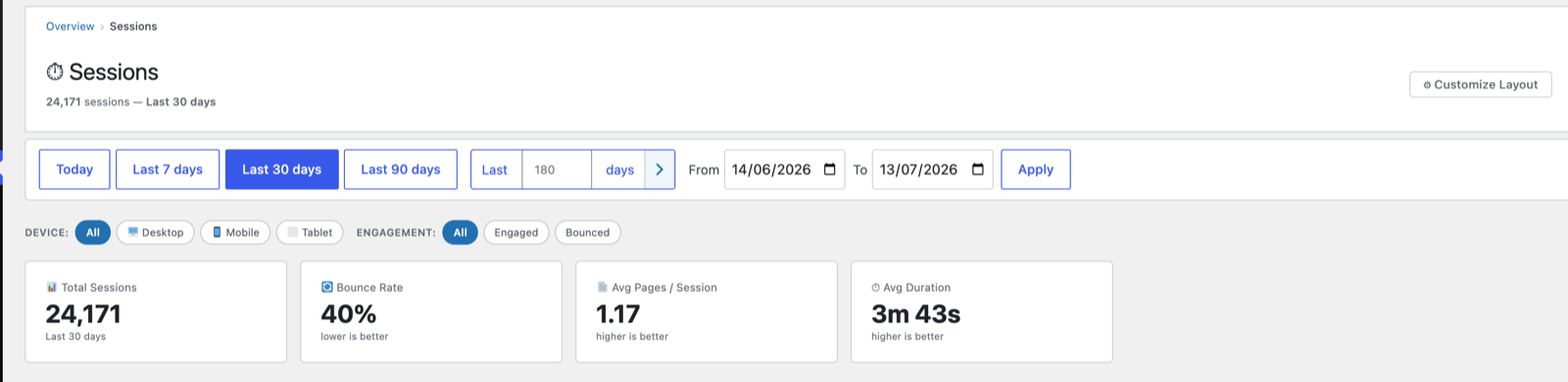
This is the screen where PAJ Statistics’ accuracy shows most clearly, so it’s worth understanding what makes these numbers different before reading the table.
Why these numbers are more trustworthy
Most analytics tools judge a session with a single crude rule: one page view equals a bounce. Time is then inferred from the gap between page loads, which means the last page of every visit — and every single-page visit — scores zero seconds.
For a content, media or music site, that’s not a rounding error. It’s a systematic libel of your best visitors: the reader who lands on one article and stays fifteen minutes is filed as a zero-second bounce, identical to a bot that touched the page and vanished.
PAJ qualifies each session on three independent axes, and they compound.
1. “Engaged” means something real
A session counts as Engaged if any of these is true:
- the visitor viewed 2 or more different pages, or
- they spent meaningful engaged time on a page, or
- they scrolled well down a page and registered some real dwell time.
So a one-page visit where somebody genuinely read your article is correctly counted as engagement, not written off. Two refinements keep it honest in the other direction:
- Reloads don’t count as pages. The “pages” test uses distinct pages, so refreshing one page five times is still a bounce — the table marks these “same page” so you can see why.
- Scroll alone isn’t enough. Short pages report 100% scroll the instant they load, so the scroll test also requires real dwell time. An instant bounce on a short page can’t disguise itself as engagement.
2. The time behind it is real time
Engaged time is measured in the browser — visible time only, paused when the tab is hidden, and gated on activity so a parked tab stops accruing about a minute after the last interaction. Crucially, PAJ can measure the final page of a visit, which gap-based tools structurally cannot.
The practical effect: your engaged-time figures are usually higher than other tools report, and your bounce rate lower — not because PAJ flatters you, but because it can see the engagement the others are blind to. See Understanding your metrics.
3. You can see whether a person was there at all
Every session carries an input signal, shown beneath its Engaged/Bounce badge:
| Chip | Meaning |
|---|---|
| 🖱 Real input | A genuine mouse move, key press, scroll wheel or touch was recorded — a strong signal a person was present. |
| ▶️ Media played | No input device, but embedded media played. Often a real listener: a tap inside a YouTube or SoundCloud player is invisible to the page. |
| ⌨️ No input signal | Neither was seen — typical of automation. |
Reading it together with the engagement badge is where it earns its keep:
- Engaged + 🖱 — a real, valuable visit.
- Bounce + ⌨️ — almost certainly automation.
- Engaged + ⌨️ — the interesting anomaly. Worth opening: long engaged time with no human input at all is the signature of an automated browser holding a page open.
No other axis can be faked into agreeing with the others, which is what makes the combination trustworthy. For the full detection picture see Bot detection explained.
Headline cards
- Total Sessions in the range.
- Bounce Rate (lower is better).
- Avg Pages / Session (higher is better).
- Avg. time — average engaged time per session.
Filters
Two filter rows narrow the table:
- Device — All / Desktop / Mobile / Tablet.
- Engagement — All / Engaged / Bounced. This is the fastest way to cut straight to the visits that mattered. “Engaged” here uses the full three-part definition above, so it surfaces genuine single-page readers that a simple pageview-count filter would hide from you.
The sessions table
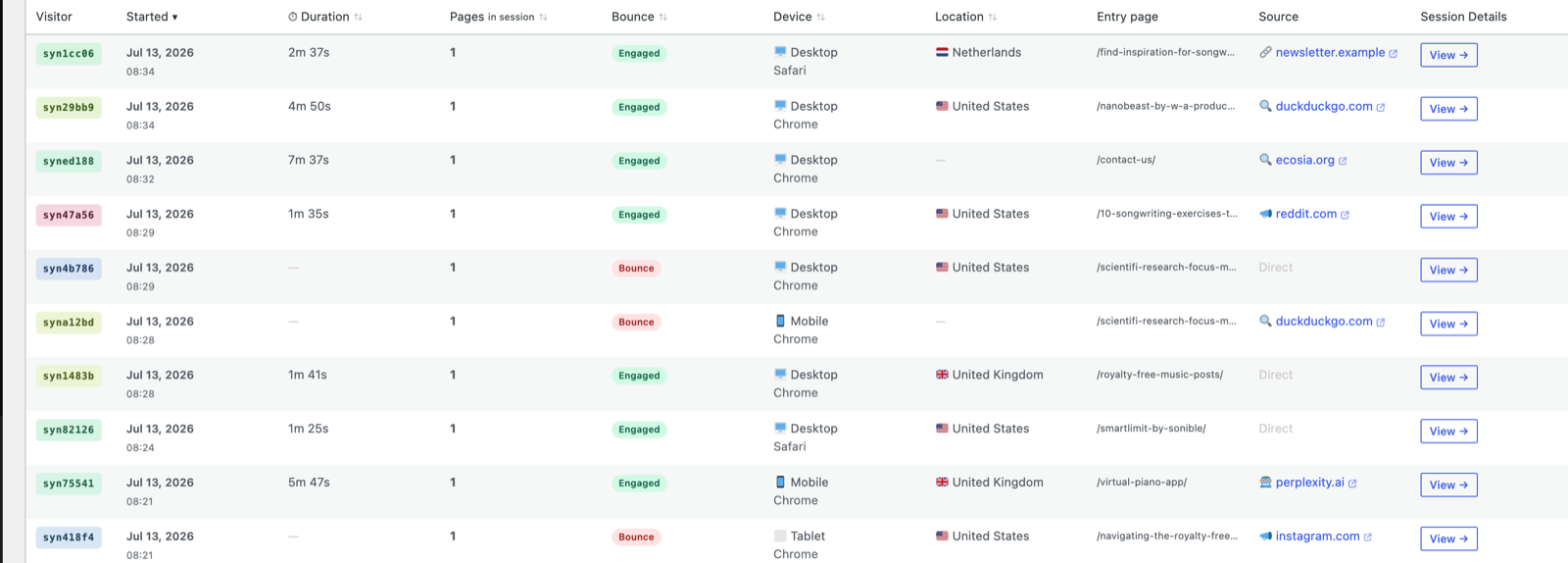
Each row is one visit:
| Column | Meaning |
|---|---|
| Visitor | The visitor’s coloured ID chip — click it to open that visitor’s full profile. |
| Started | Date and time the session began. |
| ⏱ Duration | Engaged time for the session. A — means no activity signal arrived at all: the visitor left before the first heartbeat, or it’s automated traffic that never runs the tracker. |
| Pages in session | How many pages were viewed. |
| Bounce | An Engaged or Bounce badge, with the session’s input signal chip beneath it. |
| Device | Device type + browser. |
| Location | Country. |
| Entry page | The first page of the visit (where they landed). |
| Source | Where they came from — search engine, referrer or Direct. |
| Session Details | View → opens the full session: the page-by-page path, timings and source. |
Every column is sortable. Combined with the filters, this lets you answer questions like “show me bounced mobile sessions from last week”, “which entry pages produced the longest engaged visits” — or, now, “which of my engaged sessions had no human input behind them.”
Next: Referrers & traffic sources →
Screenshots are illustrative — see the note on the documentation index.